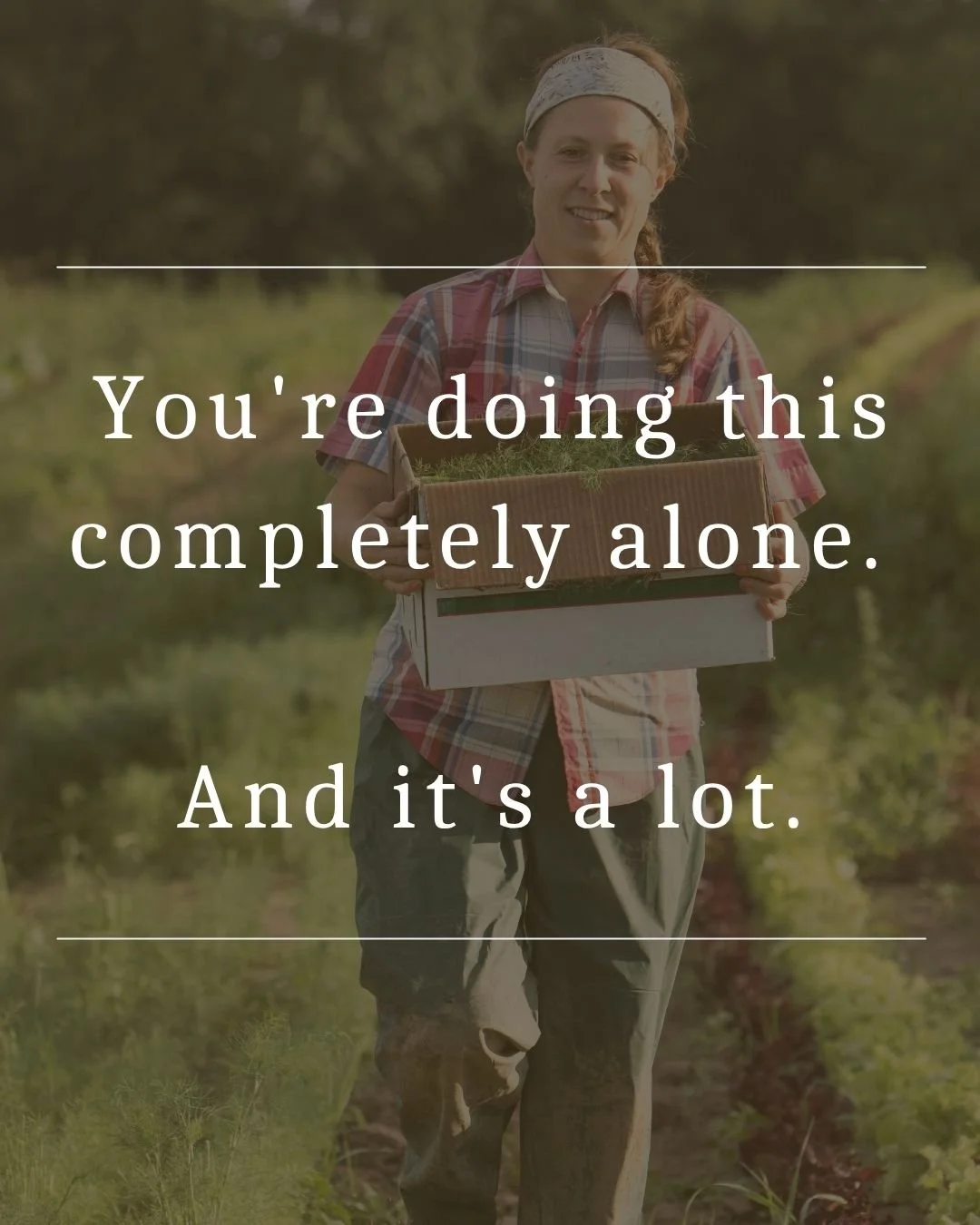
You're doing this completely alone. And it's a lot.
There's no one to hand the problem to.
The fence breaks and you fix it. The animal is sick and you make the call. The equipment fails and you figure it out. The delivery is due and you load it, drive it, unload it, smile at the customer, drive home, and start again.
There's no partner to tag in. No employee to delegate to. No one to say "I've got this, you go rest."
It's just you.
And some days, that feels like freedom. You make every decision. You answer to no one. You built this with your own two hands and it's yours.
But other days (more days than you admit) it's just heavy. The weight of being everything to this farm, all the time, with no backup.
You're a solo farmer. And that's a particular kind of hard that doesn't get talked about enough.
The math doesn't work
Let's just name it: the math doesn't work.
One person. Every role. Seven days a week. Fifty-two weeks a year.
You're the farmer, the marketer, the bookkeeper, the mechanic, the customer service rep, the IT department, the janitor, and the CEO. You make the strategic decisions and you also unclog the drain.
There's no specialization. No "that's not my pay grade." No handing off the parts you're bad at or hate.
It's all your job.
And there are only so many hours. Only so much energy. Only so much of you to go around.
The math doesn't work. But you make it work anyway.
Because what choice do you have?
No one to process with
When something goes wrong, you carry it alone.
The crop failure. The difficult customer. The financial stress. The doubt about whether any of this is worth it.
There's no one at dinner to say, "you won't believe what happened today." No partner who understands because they were there. No colleague to vent to who gets the context.
You can call a friend, but you have to explain everything from the beginning. And by the time you've explained it, you're too tired to actually process it.
So you don't. You just carry it. Add it to the pile of things you're holding alone.
The isolation compounds everything. A problem shared is a problem halved, but you don't get to share. So every problem stays whole.
No backup when you're down
What happens when you get sick?
The animals still need feeding. The crops still need harvesting. The customers still expect their orders.
There's no calling in sick. No one to cover. No safety net.
So you work sick. You work injured. You work exhausted. You work through the thing that should have you in bed because there's no alternative.
And you push through things you shouldn't push through, because stopping isn't an option. Until it is… and then it's a crisis.
The fear of that lives in the background all the time. What if I get really sick? What if I get hurt? What if I can't?
You don't talk about it because talking about it makes it real. But it's there.
The physical reality
Some things are just harder alone.
The equipment that needs two people to move. The animal that needs restraining while you treat it. The task that would take 20 minutes with help and takes two hours by yourself (or doesn't get done at all).
You've rigged up workarounds. You've figured out how to do two-person jobs solo. You've gotten creative and strong and resourceful in ways that would impress anyone watching.
But it costs. It takes longer. It wears on your body. And sometimes it' is straight up just not safe!
You've probably done things alone that you shouldn't have. Taken risks because there was no one to help and it needed to happen. And you got away with it… until maybe someday you won't.
That's not a character flaw. That's the math of solo farming. But it's worth naming.
Being taken less seriously
Maybe this one doesn't apply to you. But maybe it does.
The equipment dealer who talks past you. The old-timer who offers unsolicited advice. The customer who asks if your husband does the "real work."
Or the subtler version: the assumption that your operation must be small, a hobby, not a real farm. The surprise when you know what you're talking about. The condescension disguised as helpfulness.
You've learned to navigate it. To prove yourself over and over. To let it roll off because you don't have energy to fight every small slight.
But it accumulates. The extra labor of being underestimated. The tax of having to be twice as competent to be seen as half as capable.
Not every solo farmer experiences this. But many do. And it's exhausting on top of everything else.
The loneliness under the independence
You chose this. Or at least, you chose something that became this.
And there's genuine freedom in it. You don't have to negotiate every decision. You don't have to manage anyone else's feelings or ego or pace. You can work how you want, when you want.
But freedom and loneliness can coexist.
You can love the solitude of early morning chores and also ache for someone who gets it.
You can value your independence and also feel the weight of having no one to lean on.
You can be proud of what you've built alone and also exhausted by how alone you are in it.
Both things are true. It doesn't make you ungrateful to admit the hard parts.
What you've learned to do without
You've probably stopped noticing all the things you've adapted to.
The tasks you've given up because they require two people. The opportunities you've passed on because you couldn't scale to meet them alone. The equipment you don't buy because you can't operate it solo. The markets you don't try because you can't be in two places at once.
You've constrained your vision to match your capacity. Which is wise. But also limiting.
And you've learned to do without support in ways you might not even recognize anymore. Without someone to notice you're struggling. Without someone to celebrate the wins. Without someone to say "you're working too hard" and actually be able to do something about it.
You've done without for so long that you've forgotten you're doing without.
The stories you tell yourself
When you do it all alone long enough, you start to believe that's just how it has to be.
"I can't afford help."
Maybe. But have you actually run the numbers? Or is that a story?
"No one would do it right."
Maybe. But is that true? Or is that a way of protecting yourself from having to trust someone?
"I don't have time to train anyone."
Maybe. But is the time you'd invest in training really more than the time you're losing doing everything yourself?
"This is just how solo farming works."
Maybe. But does it have to be?
I'm not saying you're wrong. I'm saying it's worth questioning the stories. They might be true. Or they might be cages you've built without realizing it.
Some things I want you to know
You're not weak for finding this hard. You're doing the work of multiple people. Every day. With no backup. Anyone would find this hard. The fact that you're still going is remarkable, not expected.
Asking for help isn't failure. Somewhere along the way, you might have decided that needing help means you're not capable. But capable people ask for help. That's part of how they stay capable.
You don't have to do it all to be legitimate. You don't have to prove anything to anyone. The farm doesn't have to be a certain size. You don't have to do it the hardest possible way. You're allowed to make it easier on yourself.
Sustainability includes you. A farm that requires you to work until you break isn't sustainable. Your capacity matters. Your limits matter. Building a farm that respects them is survival.
You're not as alone as you feel. There are other solo farmers out there, feeling exactly this way, wondering if they're the only one. You're not. The isolation is real, but so is the community you haven't found yet - or haven't had time to find.
The invitation
What if you stopped pretending this was easy?
What if you let yourself feel how heavy it actually is - not to wallow in it, but to finally be honest about it?
What if you admitted you need something (support, help, connection, rest) even if you don't know how to get it yet?
The first step is naming it. You're doing this alone. And it's a lot.
If this resonated, you might also like:
Farming is lonely. Nobody told you that. — The isolation that compounds everything
You're the strong one and you're exhausted by it — When being capable becomes its own weight
The spoon theory for farmers — Why your energy is finite when you're doing everything alone
You're doing a good job. Even when there's no one there to tell you.
If you need someone to talk to who gets how hard solo farming is (or help figuring out what might need to change), I'm here.
You can schedule a free chat with me anytime at FarmCoachKatia.com/work-with-me.