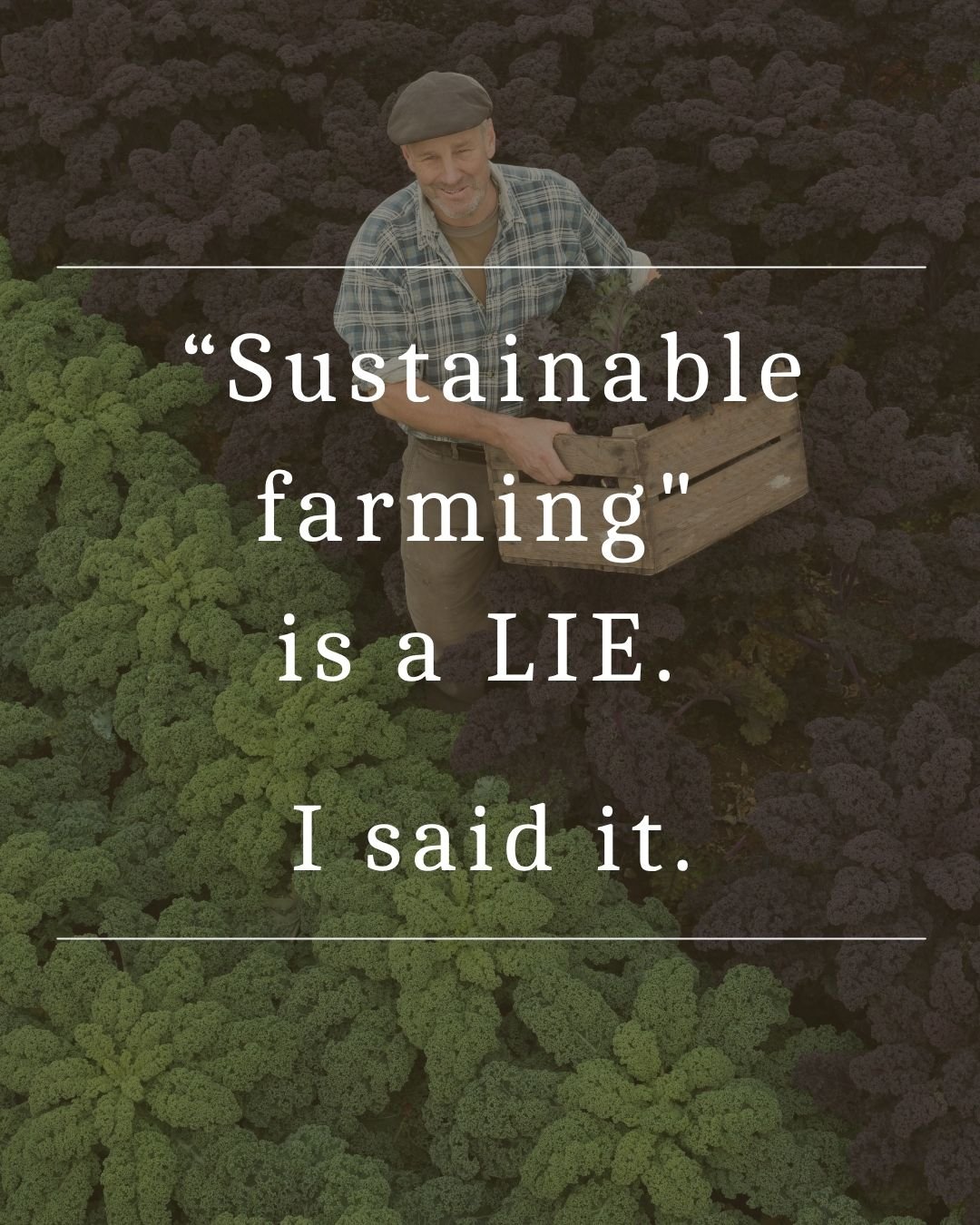
Sustainable farming is a lie (I said it!)
You're doing everything right.
Cover crops. Compost. Rotational grazing. No-till. Pollinator habitat. You're building soil, sequestering carbon, raising animals ethically, growing food that actually nourishes people.
You're the poster child for sustainable agriculture.
And you're exhausted, broke, and wondering how much longer you can keep going.
Here's the quiet part we don’t say outloud: sustainable farming, the way the industry and consumers define it, is a lie.
Not because the practices are wrong. Because the definition is incomplete.
The lie we've been sold
When people talk about "sustainable farming," they almost always mean one thing: sustainable practices.
Soil health. Ecological balance. Regenerative methods. The environmental piece.
And that piece matters. It matters a lot.
But somewhere along the way, we decided that was the whole picture. That if you're farming in a way that's good for the land, you're farming sustainably.
Meanwhile, the farmer is burning out. The business is barely breaking even. The family is strained. The lifestyle is anything but sustainable.
But the soil looks great. So we call it sustainable.
That's not sustainability. That's a marketing story that makes consumers feel good while the farmer falls apart.
Real sustainability has three legs
Think of it like a stool. Three legs, all required:
Leg 1: Sustainable practices
The environmental piece. Soil health, ecological balance, regenerative methods. The part everyone talks about. Every farmer or rancher I have partnered with cares about this part a lot.
Leg 2: Sustainable business
The financial piece. A farm that's solvent. That makes a profit. That can pay the farmer a living wage and weather a bad year. The part people assume is your problem to figure out.
Leg 3: Sustainable lifestyle
The human piece. A farmer who isn't burning out. Who has rest, relationships, health, joy. A life that can continue for decades without destroying the person living it. The part almost no one talks about.
If any leg is short or missing, the stool falls over.
You can have perfect soil health and go bankrupt. You can have a profitable business and destroy your marriage. You can have practices and profits and still burn out completely.
A farm isn't sustainable unless all three legs are solid. And right now, most "sustainable" farms are balancing on one leg and pretending that's enough.
The gaslighting of small farmers
Here's where it gets painful.
Small farms have become synonymous with sustainable farms. In the cultural imagination, "small" equals "good." Local. Ethical. Sustainable.
Customers feel great buying from you. Communities celebrate you. The farmers market crowd loves the story of the small family farm doing it the right way.
And you smile and play the part because that's what sells.
But behind the scenes?
You haven't taken a real day off in months. Your partner is frustrated. Your body hurts. You're not paying yourself a living wage (or any wage). You're one bad season away from going under.
You've been told you're the model of sustainability. Meanwhile, the life you're living is completely unsustainable.
That's gaslighting. And it's happening to small farmers everywhere.
Why we don't talk about the other two legs
The business leg: Talking about profit feels dirty in sustainable agriculture circles. Like you're betraying the mission by wanting to make money. So we don't talk about it. We pretend passion is enough. We treat financial struggle as noble instead of recognizing it as a structural problem.
The lifestyle leg: Talking about burnout feels like weakness. Like you're complaining about the life you chose. So we don't talk about it. We push through. We wear exhaustion like a badge of honor. We accept that the farmer getting crushed is just part of the deal.
Meanwhile, the soil gets all the attention.
We obsess over soil health. We read books about it, take courses about it, test for it, build whole farming philosophies around it.
And we put almost no energy into the health of the business or the human running it.
Imagine if we poured as much care into our financial sustainability as we pour into our soil.
Imagine if we built systems for our own wellbeing with the same intention we bring to building soil biology.
It would be different. Everything would be different.
The uncomfortable truth
You can't regenerate the land while depleting yourself.
You can't build something that lasts while running a business that doesn't make money.
You can't be a poster child for sustainability while living a life that's slowly destroying you.
At some point, the math catches up. And the farmer who sacrificed everything for "sustainable" practices either burns out, goes broke, or quits.
And then what? What happens to that sustainably-managed land when there's no one left to farm it?
The practices only matter if the farmer can keep doing them. And the farmer can only keep doing them if the business works and the lifestyle is survivable.
All three legs. Or it falls.
What actual sustainability looks like
It looks like a farm that makes money. Real money. Enough to pay yourself fairly, save for the future, and survive a bad year.
It looks like a farmer who rests. Who has boundaries. Who isn't running on fumes and calling it dedication.
It looks like relationships that aren't getting scraps. A body that isn't breaking down. A life that includes more than work.
It looks like practices AND profit AND a person who can sustain this for decades.
That's harder than just cover cropping. That requires building three things at once, not just one.
But that's what sustainability actually means.
The work we're not doing
Most of us spend 90% of our energy on the practices. The production. The farming itself.
And almost nothing on the other two legs.
We don't build financial systems. We don't learn business fundamentals. We don't price properly, track numbers, or treat the farm like a business that needs to be solvent.
We don't protect our capacity. We don't build rest into the structure. We don't set boundaries or design a lifestyle that's actually livable.
We pour everything into the soil and wonder why we're depleted.
What if you gave the business leg as much attention as the practices leg?
What if you invested in your own sustainability the way you invest in the land's sustainability?
What if you decided that all three legs matter equally — because they do?
Building the other two legs
For the business leg:
Know your numbers. All of them. Religiously.
Price for profit, not just survival.
Stop treating financial health as optional or shameful.
Get help - a bookkeeper, a coach, a mentor who understands farm finances.
Accept that a sustainable business must make money. That's not selling out. That's staying in business.
For the lifestyle leg:
Rest is not a reward for finishing. It's a requirement for continuing.
Build boundaries like you build infrastructure.
Stop wearing burnout as a badge of honor.
Get support - coaching, therapy, community, whatever helps you see what you can't see alone.
Accept that you matter. Your health, your relationships, your joy. They're not extras. They're foundations.
The permission you might need
You're allowed to want a profitable farm. You're allowed to want a life that doesn't destroy you. You're allowed to stop sacrificing yourself on the altar of "sustainable agriculture."
The customers who feel good about buying from you? They don't see what it costs. The community that celebrates small farms? They're not paying your bills or resting your body.
You're the one living this. You're the one who has to sustain it (or not).
You get to redefine what sustainability means for your farm. And it better include you.
The real definition
A sustainable farm is one where:
The land can keep producing. The business can keep operating. The farmer can keep going.
All three. No exceptions.
Anything less isn't sustainable. It's just a slow-motion collapse with good marketing.
If this resonated, you might also like:
The farm gets everything. You get the scraps. — When the lifestyle leg is missing
What is farmer burnout? — The cost of ignoring your own sustainability
You are the most important asset on your farm — Why your wellbeing isn't optional
You're doing a good job. Even when the stool is wobbling.
If you need help building the legs that have been neglected — the business, the lifestyle, the parts no one teaches you — I'm here. You can schedule a free chat with me anytime at FarmCoachKatia.com/work-with-me.